
Englefield in World War 2
The Hospital in World War 2
In the summer of 1940 Englefield House was again opened as a Red Cross Auxiliary Hospital and voluntary helpers were called for.
In 1940 all 20-year-olds had to register for national service and Emily Cook, who with her father and mother ran the Englefield sub-post office and Working Men’s Club, went to the labour exchange at Pangbourne. She was relieved to be told that working at the post office was a reserved occupation. Nevertheless, like others from the village she volunteered as an auxiliary helper at the hospital and on 14th August 1940 was enrolled in the Berkshire 46 Detachment of the Red Cross, as a General Duties member. She had already attended first aid classes in the school given by the Civil Defence and even learned to deliver a baby in an emergency. More instruction followed, in the Drawing Room at Englefield House. “At first, we were quite a crowd but over the years we dwindled down to two or three”, she said.
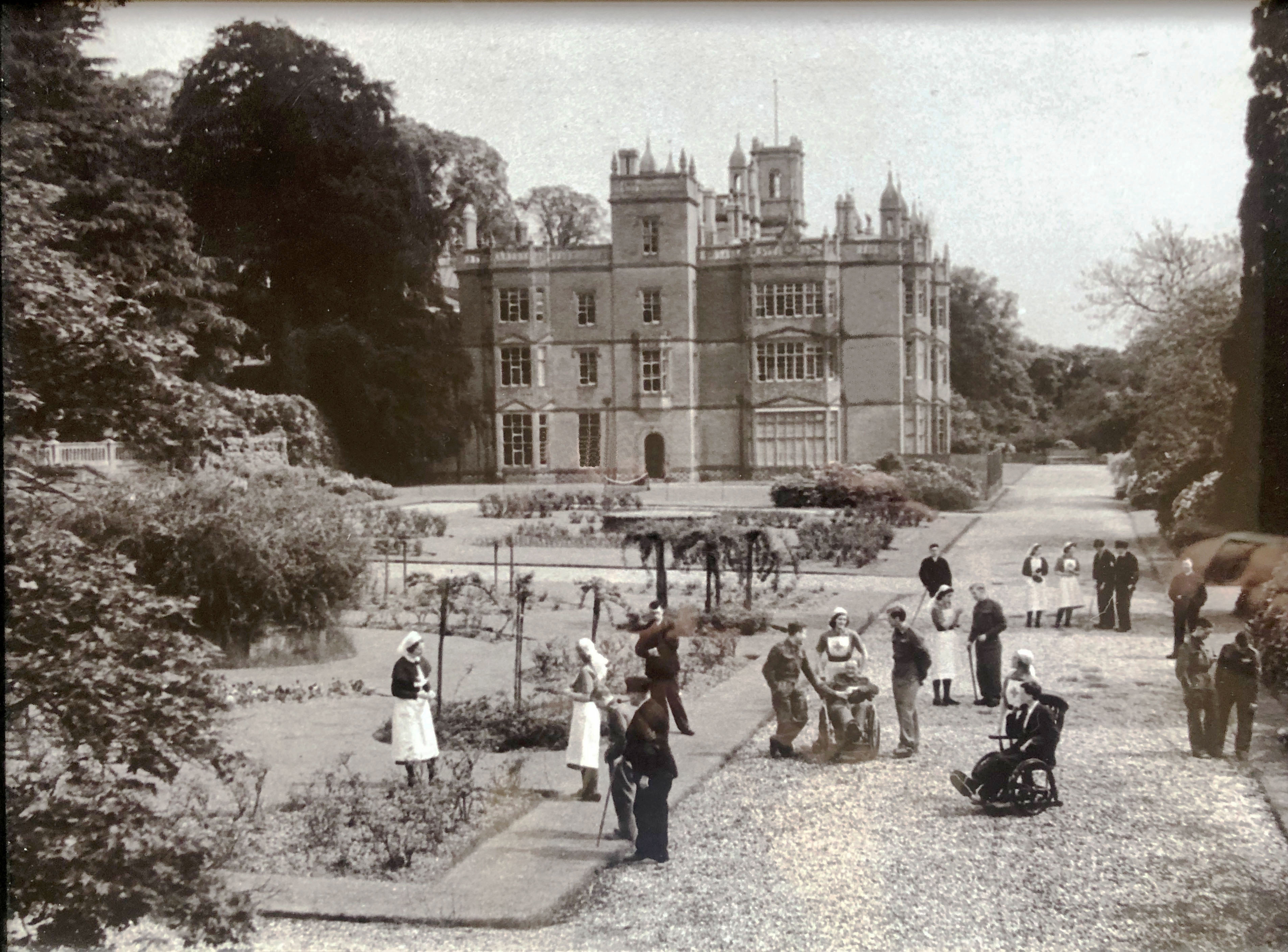
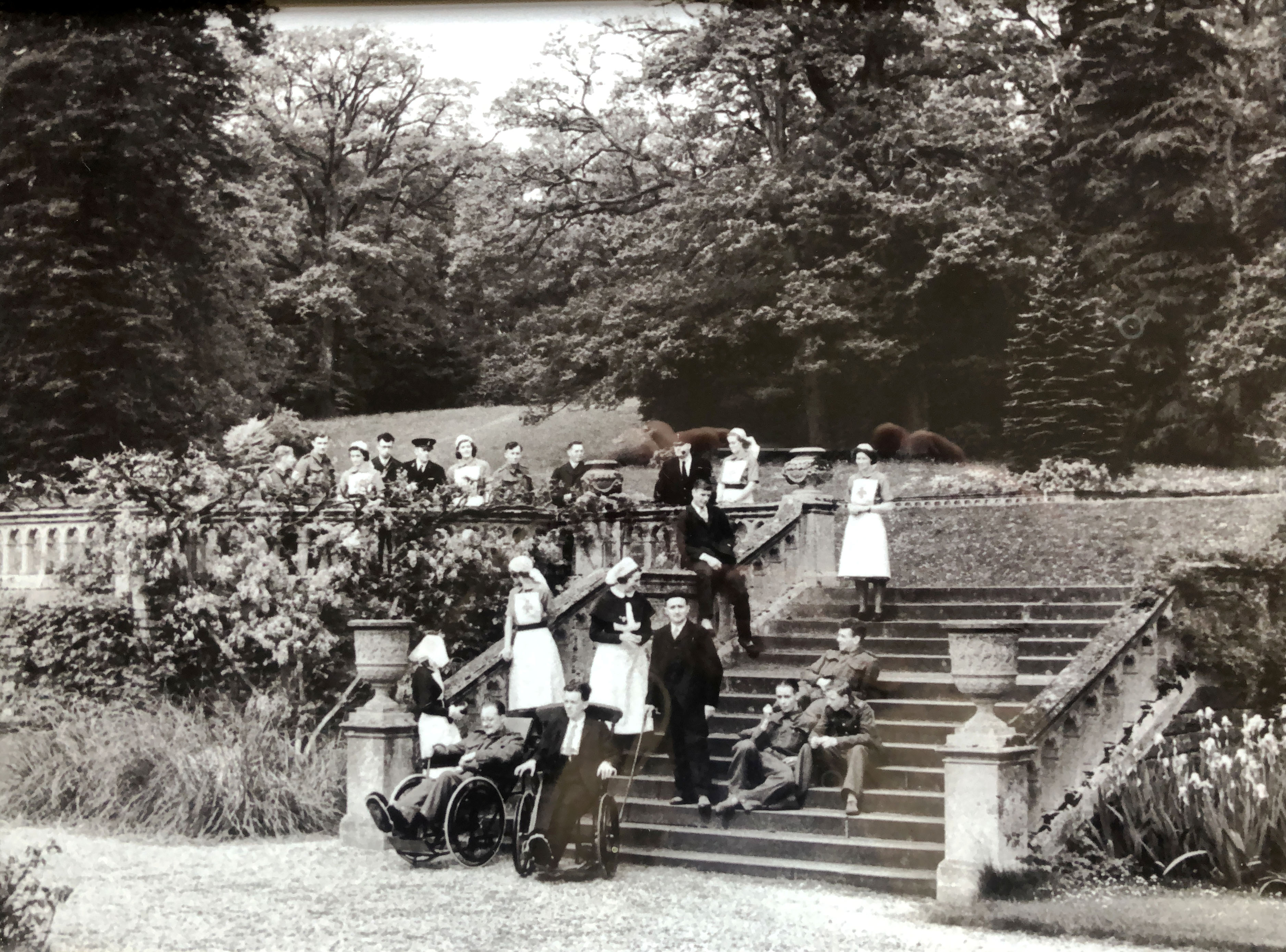
The hospital was for convalescent patients and most stayed for 14 days. Ambulances brought them from Woolwich and Haslar (Gosport) hospitals usually. Most were not confined to bed so on arrival the first visit would be to the post office to buy a view postcard and send their new address home. They were able to stroll in the grounds of Englefield House and also to use the Workmen’s Club.
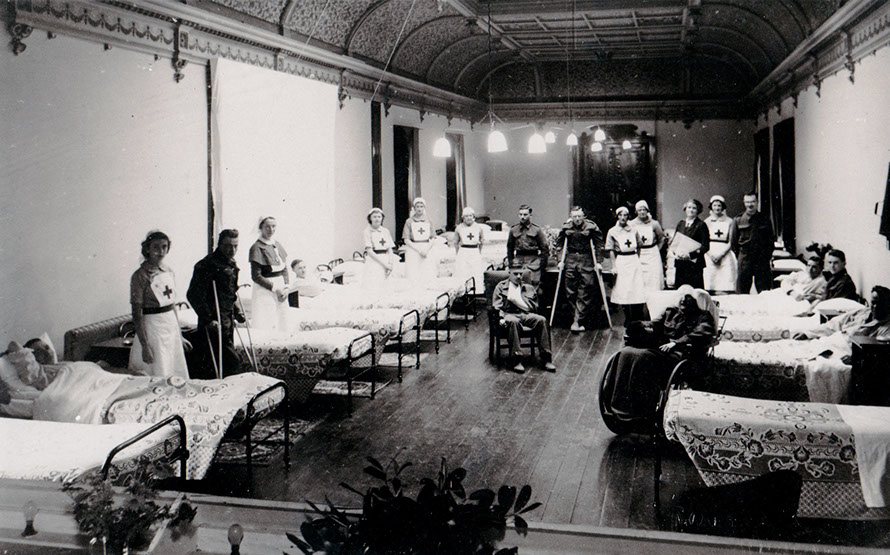
The Long Gallery as a hospital ward during the Second World War
As she was serving in the post office during the day, Emily Cook’s shift at the hospital was in the evening.
My stint was from 6pm till 9pm and my duties were cutting bread and butter, or margarine and butter mixed together, laying out the dining hall for supper, washing up, then laying up the staff supper tables in the library. This consisted of three very large round tables and it was important to remember the pecking order, top table senior staff, centre table nurses and bottom table below-stairs minions, about 30 places in all. Everyone had their own butter dish, sugar pot etc and everybody had their own place, so a good memory was needed. You didn't dare put the wrong pots in the wrong places. A bit difficult at first but with the help of Ruby, Nancy and Pat I soon got the hang of it. Of course, after supper it was back to the sink and more washing up but between us we made light work of it. Once a fortnight we would have to clean the cutlery with Silvo polish and as this left a nasty taste on the spoons and forks it all had to be washed afterwards. It was quite a pile, 80 patients plus the staff, but we girls had hijinks.
Jessie Dobbie, the Housekeeper in 1914, had been Quartermaster then and she was still Housekeeper in 1940. The Assistant Quartermaster was Miss Bright from Henley. and Emily would assist her with doling out the patients’ supper.
It was it usually shepherd’s pie and each container served eight. The patients would file past the serving table holding out their plates and as they all wore hospital blues it was impossible to tell if they were squaddies or jolly jack tars. Might even have been airmen among them. Hospital blues comprised the saxe blue jacket and trousers, white shirt and red tie, (very patriotic). The idea being that they would stick out like a sore thumb if they were out of bounds.
After a while Miss Bright asked me if I could manage suppers on my own as Tuesday, being her day off, meant she could get an extra evening at home. So when I arrived her baby Austin would be ready and waiting and off she would go to be home in time for dinner. Of course I was terribly nervous, the sight of those 80 pairs of eyes all fixed on me it was very scary. Also I was worried that I would end up with half of them to serve and no shepherd’s pie left. I was ably assisted by the Corporal in charge, a nice man of mature years called Corporal Ambrose.
There was, inevitably, a certain amount of banter, all very harmless but nevertheless all very confusing for a young lady concentrating hard on her task. One evening in the middle of it in walked Matron known to the men as ‘the old battleaxe’. For once she was a welcome sight and shortly afterwards Miss Bright was gone. Miss Dulcie Bucknell from Purley took her place. Instead of doing suppers Emily was then given other jobs like darning piles and piles of army socks.

Entertainment for the patients was provided by ENSA: films every other Friday and in between a concert. Later there was a Wednesday fortnightly film show provided by the RAF. Emily Cook continues:
"This was presided over by a Flight Sergeant and Sergeant. On film nights I would go early and give the girls a hand with the washing up or they would have missed half the show. As it was we always arrived just as the lights were going out, no seats left, so we were obliged to perch on the side of one of the beds which had all been pushed to the back of the Long Gallery.
This could prove a bit chilly in winter as the van with the motor that supplied the power to the projector was parked just outside under the canopy and there were large cables coming in which prevented the door from closing. Add to this the fact that we were unable to lean back so there we were perched like five little swallows on the telephone wires. Should one's back begin to ache the only relief was to lean back on one's hands".
Royal visits
The hospital was visited twice by royalty. In 1942 Her Majesty the Queen came amid great excitement and all the staff were placed at particular positions. After a tour of the kitchen and still room Mrs Benyon escorted Her Majesty along the dim, long corridor leading to the front of the House. This was reached through a very heavy swing door and Emily Cook had the job of holding it open for them to pass through. “When they got to me HM paused and looked at Mrs Benyon who then said, ‘This is Miss Cook one of our voluntary helpers’. I shall never forget that beautiful smile, the flawless cheeks and eyes the blue of dog violets. ‘Well done’, she said, ‘keep up the good work’, and passed on to the front hall to meet the top brass”.
The staff had been tutored on the protocol for curtseying beforehand, just a bob if spoken to, deep curtsey if hand shaken. “I stood to attention, had I moved to bob we should all have been swept into the hall by the door swinging shut as it was taking all my effort to hold it open.”
On another occasion the hospital was visited by HRH the Princess Helena Victoria (a granddaughter of Queen Victoria) and the auxiliary helpers were all placed in the dining hall, presumably getting the patients tea ready. “HRH was an imposing looking lady but she turned out to be very jolly and friendly, insisting on shaking hands with each of us”.
The Princess walked around the two long tables, all perfectly laid, and down the centre of each were huge dishes of hot house tomatoes from the gardens. After commenting how lucky the patients were to have such luxuries she waved and left. “I wonder what she would have thought if she’d come back minutes later to find said tomatoes being removed”.