
World War 2
The gathering storm
The Second World War, like the First, was seen coming a long way off, with a prescient article in the Daily Telegraph by an unknown author as early as January 1923. Winston Churchill was another (The Gathering Storm was the title of the first volume of his memoirs) and it is generally accepted that he was alone in warning against the policy of appeasement practised as Hitler’s National Socialist Party disregarded the Versailles Treaty by rearming and then annexing the Rhineland, Austria and Czechoslovakia between 1933 and 1939. A more contentious issue is whether the policy made any difference to the outcome. One thing it certainly did, perhaps, was buy some essential time and despite the combined efforts of mere appeasers and active Nazi supporters in the country, the introduction of (just) sufficient numbers of the Spitfire and Hurricane fighter aircraft and their pilots, and the development of Radar were key to the success of the RAF in what was soon to come.
The Spanish Civil War in 1936 had provided a dress rehearsal for the Luftwaffe so preparations in anticipation of the expected air raids started the following year with the creation of the Air Raid Precautions system and the enlargement of the Territorial Army and the RAF Reserve. It is estimated that about half a million people volunteered for one or other of these, among them James Cook and his great pal Harry Day who joined the Royal Engineers Territorial Army at Reading. Conscription was also introduced and in May 1939 the first group of men aged 20-22 reported for six months full-time military training with a second mixed group of volunteers and conscripts joining in September.
Lessons had been learned from the previous war, though, when there had been a critical shortage of civilian labour in some areas in 1914/15 owing the the great numbers of men who volunteered to fight. The reserved occupations list was published in 1939 and contained a very large number of occupations, in great detail and covering some five million men, that were considered vital to the war effort in their civilian jobs. In some cases the occupation was reserved at any age but in the majority of cases a minimum age applied. Thus most workers in agriculture or horticulture could be accepted into military service as volunteers up to the age of 25 but not if they were older than that. Carpenters, bricklayers and blacksmiths were reserved at any age and, oddly, a band or circular sawyer was reserved only from the age of 30 while a general hand in a timber yard was reserved at any age.
The reserved occupations list meant that few of the men in Englefield could volunteer, or would be conscripted, as they were mostly in reserved occupations but when in 1940 the call did go out for volunteers to form the Home Guard, a good number came forward.
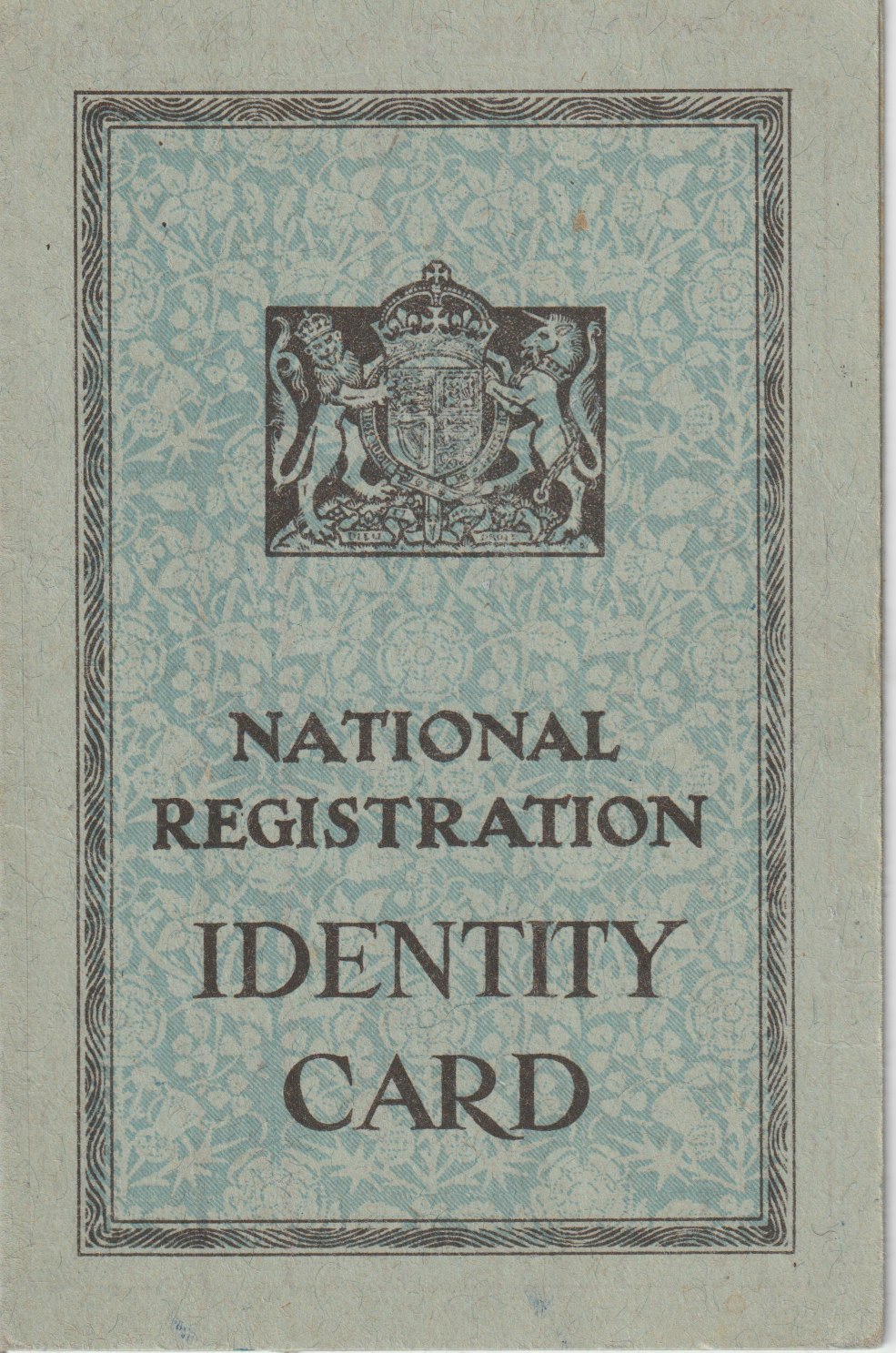
Also in 1939 the National Registration Act created a National Register of every man, woman and child in the country on 29th September 1939 and everyone was issued with an identity card that had to be carried at all times. The card did not have a photograph, simply name and address, for most people, although people who needed particular proof of identity were given a special card with a photograph. Those in positions such as Air Raid Wardens had a civilian card with an extra page showing identification particulars and a Certificate of Official Capacity signed by someone in authority. The original cards were buff in colour for everyone and cards were re-issued in 1943 in the blue colour shown here.
Unlike a normal census, the Register was continuously updated, as women changed their name on marriage for example, and identity cards continued to be issued to new-born infants long after the war had ended. New cards were also issued to servicemen on demobilisation after the end of the war and the requirement to carry an identity card was not actually abolished until 21st February 1952.
It is somewhat disturbing to speculate on what part Englefield might have played had the Royal Navy and the "little ships" not managed to rescue a significant proportion of the Army from Dunkirk and other French ports in May/June 1940, and the Royal Air Force not successfully resisted the Luftwaffe through the following months when Britain and her empire stood alone. At that time Englefield found itself at a focal point in the land defences of the country, although far inland from any seaborne invasion. In June 1940 there began the hurried construction of a series of "stop lines": defensive lines dividing the country into compartments and intended to fix an invader long enough to allow a counter attack to be concentrated on him.
The most important of these lines was the General Headquarters line (GHQ line), in fact a network of defensive lines, protecting London. GHQ Line Blue followed the Kennet and Avon Canal from Theale to Bradford on Avon and GHQ Line Red ran from Theale through the Sulham Valley to Pangbourne and then along the river Thames to Abingdon and beyond.

The "vital hinge": Line Red and Line Blue meeting just to the east of Theale

The Kennet Valley and GHQ Line Blue seen from the top of Common Hill
Along the natural barriers provided by these waterways was constructed a large number of concrete "pill boxes" to provide cover for troops manning machine guns and anti-tank weapons. In the Sulham Valley the River Pang did not provide a sufficient natural barrier so an anti-tank ditch some 55 yards across was dug along the valley and supplemented by various other anti-tank measures such as the concrete "dragon's teeth" which were clearly visible long after the war ended but have now gone.
The area around the intersection of Line Red and Line Blue, a vital "hinge" to be forced open to allow an assault on London, would have been a particularly important strategic target for the enemy but the flat Kennet valley between two ridges of high ground (left) was an ideal location in which an advancing enemy, fixed by the necessity to cross two watercourses and the defenders in the pill boxes, could be killed by bombardment from the air and by artillery.
It is on these defensive lines that the local Home Guard would have made their stand in a second battle of Englefield 1070 years after the first.
After the war there was an attempt to remove the pill boxes but they proved so difficult to demolish that they were left as a permanent reminder. Some were repurposed and one near Ufton Lock was clad with wood and used as a shed then later as a bat sanctuary.
Another similarity with last time for Englefield was that on the eve of the declaration of war the cricket team played a match. This time it was not the friendly family affair in the park of the Timber Yard versus House and Gardens but an away match at Streatley, which Streatley won.