
A Rare Survival
“Miles of flint and good oak fencing, an estate saw mill, a deer park, a lake, then a well-conditioned red-brick model Victorian village with a Georgian house (probably for the agent), a stone rectory by P C Hardwick in mid-Victorian Tudor, a school, a big walled garden with acres of glass, a well-kept drive swirling past exotic firs and rhododendrons to a spired church, and finally an enormous stone house... All this has the overwhelming and firmly established atmosphere of the great country house of Trollope’s novels, which continued into good King Edward’s reign. It is the last of its kind in the county and worth seeing as a compact, well-run example of benevolent private ownership...”.
So John Betjeman and John Piper described Englefield in Murray’s Berkshire Architectural Guide of 1949 and the association with Trollope is well-founded because the Englefield that Betjeman saw was exactly contemporary with Trollope’s Barsetshire. It had only really come into being from the middle of the 19th century and in 1949 had changed very little since 1892, nor has it changed markedly since.
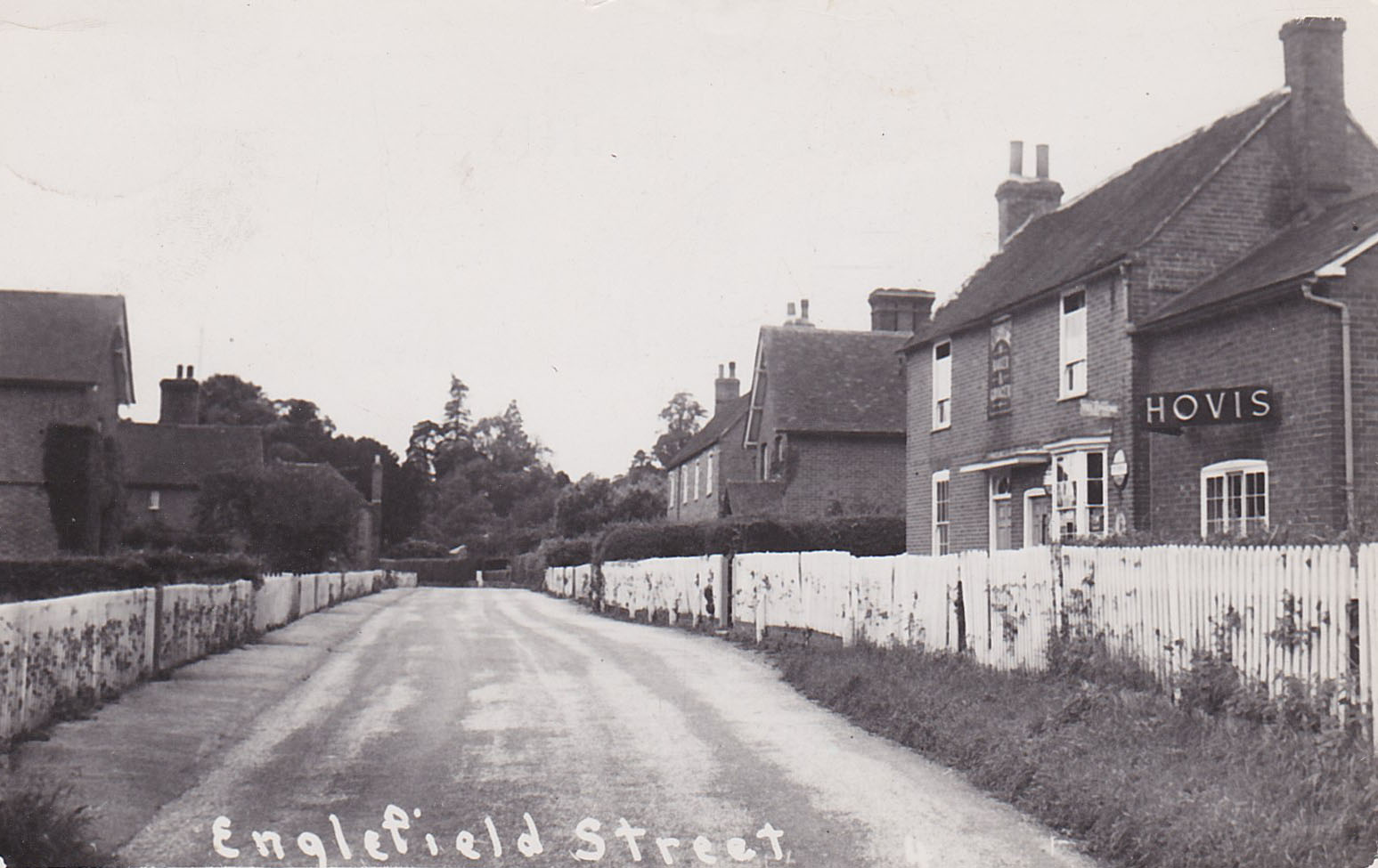
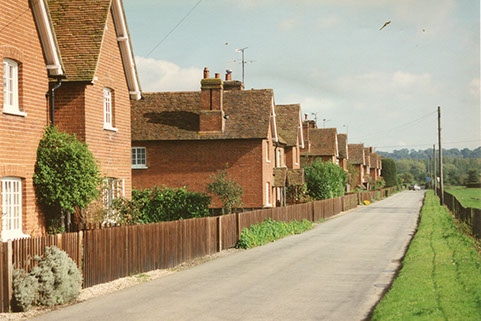
What Betjeman described was an estate village, a category that goes largely unrecognised by social historians and where mention is given at all it is largely confined to the supposed iniquities of tied cottages or the enclosures. But the 19th century estate village, particularly one like Englefield where the generous Squire went out of his way to make himself and his family a part of it, is very much the rural counterpart to the more celebrated creations of the industrial philanthropists like Salt, Lever and Cadbury. Indeed, modern Englefield is contemporary with Saltaire and pre-dates Port Sunlight and Bourneville by more than 20 years. Here was a functioning social unit - a real "community" - with modern houses set in their own gardens and comfortably spaced from one another, jobs, a school, a church and leisure opportunities all provided by the Squire and set in one agreeable and harmoniously-styled place surrounded by well-managed and productive countryside - an ideal the post-war planners have singularly failed to achieve.
Leslie North writing in the Reading Chronicle of August 1980 described his approach to the village: “…I felt – if not exactly unreal – as if stepping into something retreated from an unacceptable present.”. He was right, for “retreated” is what Englefield literally is, thanks to the new roads built by the 19th century owners. At just the right time these allowed Englefield to become the backwater it is today and prevented it from being on what would undoubtedly have become a fairly major cross-roads.
English villages, archaeologist Ben Robinson says in his book England’s Villages, have been a defining characteristic of England and the English for a long time and provided the solid social and economic backbone of the country for centuries. Definitions of a village inevitably tend to concentrate on numbers of houses and size of population and these are not irrelevant indicators but, as Robinson observes, “Much about what makes a village now and in the past is as dependent on its community as it is on built structure”.
While this was a hierarchical society in theory it certainly was not excessively so in practice. In a close community like this there are few secrets so little point in standing on one’s dignity - although some tried it. The village was a living example of Benjamin Disraeli’s “one nation” idea (the original one, not the current version): a symbiotic alliance between the landed proprietors and their rural tenants and workers. This was not surprising perhaps, as the Squire through the second half of the 19th century, the man who more than anyone was the creator of the modern village, was the Conservative MP for the county during both of Disraeli’s periods in office.
The estate provided a unifying purpose for the many people and their families that were part of the estate workforce, and the village population: carpenters, farm workers, plumbers, brickmakers, bricklayers, painters, blacksmiths, gardeners, grooms, woodsmen, keepers and the whole gamut of domestic servants.
There was constant movement of people around the village but at intervals through the working day there would be a sudden transhumance between work and home as the men returned for meals and went back to work. Each movement triggered by the sound of the timber yard hooter, which could be heard across the whole of the estate and possible only because work and home were conveniently close to one another.This was a true community, “...the last of its kind in the county...” as John Betjeman continued in Murray's Guide and this pleasant place was their England, demi-paradise, their little world; made by their own efforts.
Englefield has its origin as a Saxon (or earlier) hamlet and has survived by being continually, but sensitively, renewed. Most of what is seen today goes no further back than the 19th century with one or two bits from the 18th; even Englefield House and St Mark’s church, although of Elizabethan and Norman origin respectively, owe their present appearance to Victorian reconstruction. New housing has been built in the late 20th and early 21st century, but of an appropriate scale and design and tastefully blended into what was there before. Betjeman, who in his chapter on Berkshire in The English Counties Illustrated (1948), was appalled by “...the council houses which mutilate almost every village...[that] are generally considered to be amongst the most ill-sited, disproportioned, inharmonious and badly built houses in England [and] provide a glaring contrast with their surroundings” would surely find nothing here to criticise.