
Englefield in World War 2
Air Raid Precautions
Englefield village itself did not come under air attack in either World War but several bombs were dropped nearby during World War 2.
National air raid precautions were established well before the Second World War with the creation of the Air Raid Wardens’ Service (ARP) in April 1937 and by the outbreak of war in September 1939 there were more than 1.5 million members. The command and control system was based on the county, with the Berkshire control in Shire Hall at Reading. Sub Control points were established in Abingdon, Newbury and Wokingham, each with a number of subordinate Report Centres in the major areas of population. The Bradfield District Report Centre, based at Tyle Mill in Sulhamsted, reported direct to County Control rather than to a Sub Control. Each Report Centre controlled a number of Warden’s posts which were usually in the home of the Senior Warden or a local shop or office. First Aid Posts were established at Sulhamstead, Pangbourne and Woolhampton and Rescue Service Parties were based at Pangbourne, Woolhampton and Tidmarsh, with detatched sections at Theale and Mortimer. A decontamination squad was also based at Pangbourne.
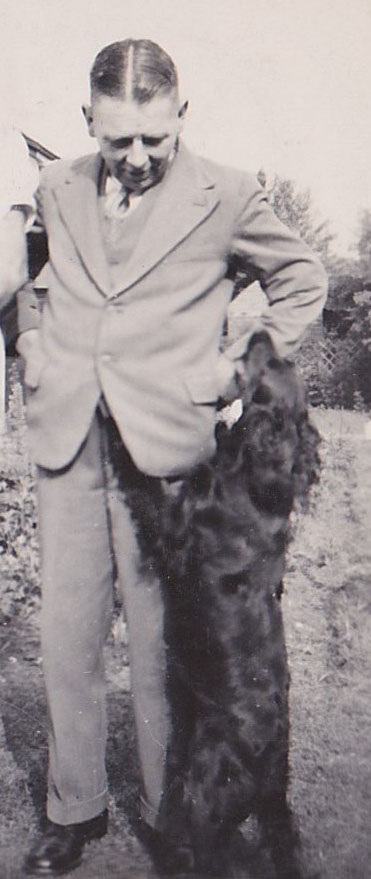
Mr Cook with Wendy
Warden’s posts were usually in the home of the senior local Warden or a local shop or office. The Chief Warden for Englefield was Mr Cook, the Club caretaker and Sub-postmaster, and the Warden’s post was at the Post Office, one of the few places in the village with a telephone at that time. Assistant Wardens were John Turnbull (the Schoolmaster), Malcolm Bath (the Head Gardener), Albert Bushell and Vic Briant, although Vic Briant later joined the RAF.
Albert Bushell lived across the Park at Parker’s Corner and Vic Briant was at 24 The Street but the Headmaster and the Head Gardener lived next door and just across the road, respectively.
One of the first jobs was the issue of gas masks. These came in individual cardboard boxes 8” x 6” and 6” deep and in were different sizes. A quantity of these were delivered to Mr Cook and so the first thing was to sort them into small, medium and large sizes. There were even a few of the special baby ones, where the whole baby was placed inside a sort of capsule. Evenings were given over to fitting of gas masks to individuals and each mask issued had to be recorded with address and signature of the recipient. Mr Cook's daughter Emily recalled:
"The new civil defence call was launched and Pa was made Chief Air Raid Warden for Englefield, with two assistant wardens, the Head Gardener and Headmaster. These two gentlemen didn't seem to put their hearts into the job and seemed to be profoundly deaf when the air-raid siren sounded during the night.
One of the first jobs was the issue of gas masks [in 1939 before the war started]. These were each in a cardboard box 8" x 6" and 6” deep and in different sizes. A load of these were delivered to father as air-raid warden and so the first thing was to sort them into small, medium and large. We had a few of the special baby ones, where the baby was placed inside a sort of capsule.
Next a large ledger was required as each mask issued had to be recorded with address and signature of the recipient. So evenings were given over to fitting of gas masks. Once you had yours you were obliged to keep it with you always or you could be stopped and asked ‘where is your gas mask?’ To carry it you could buy or make a carrier with shoulder strap similar to today's shoulder bag. I made mine from a piece cut from an old raincoat to make it waterproof".
The gas masks were duly issued to all the villagers and, as any good quartermaster would, Mr Cook did not fail to record every issue (in alphabetical order) with a name, address and signature of the recipient. A separate record was kept of the equipment issued to the Wardens.
Although there were a few potential targets around the area: airfields at Theale and Aldermaston, the ordnance factory at Theale (originally built to make cigarettes), the explosives filling plant at Burghfield and the railway junction at Reading; these were either not significant enough or sufficiently concentrated to attract deliberate air raids, although heavy anti-aircraft batteries were located at Amners Farm and what is now the Potteries estate in Tilehurst. There was also an associated searchlight battery and locator station near Milehouse, manned by 342 Searchlight Bty with its Battery HQ in the village hall at Woodcote. The battery was operational by 1 January 1939, a full nine months before the start of the War. There was also a “Starfish” decoy site at Moor Copse, just across the river Pang in Sulham, near Hogmoor Bridge. Starfish sites used huge trays of burning oil to simulate a burning town, in this case Reading, in the hope that the enemy would bomb on the fires rather than an accurate geographic location.

There were no deliberately targeted raids around Englefield but it lay on the enemy’s path to the industrial heartland of the Midlands so there were frequently aircraft overhead. Emily Cook described what happened then:
"We had already had a warning from the police by telephone, first yellow then red. Off Pa would go in his tin hat looking for lights shining from poor blackout curtains. We would get to man the telephone while he was gone. Poor mum nearly died of fright when the ack-ack opened up. Sometimes we would venture outside to watch the searchlights in action and get very excited when they caught a Jerry in the beams. There was always the fear that instead of continuing on to the Midlands they would off-load their bombs and hightail it for home. Following night after night of patrolling his very straggling beat alone father, whose temper was ever on a very short fuse, finally lost his cool completely.
His two uncooperative henchmen who lived next door and opposite to us were roused in turn by him hammering on the doors and when their sleepy heads appeared from their respective bedroom windows they were shocked by a flow of language worthy of a Sergeant Major. In no uncertain terms he informed them that it was their war as well as his and to get out and do their patrol. They were both very peeved about this. Mind you I don't think it made a lot of difference, they never took the job seriously, but it least father got it off his chest".
The various Civil Defence groups, including the Air Raid Wardens, started to be wound up in September 1944 when some blackouts began to be lifted and finally disbanded just before VE-Day, on 2nd May 1945. A dinner with 80 people present was held in the Parish Room at Theale on 27th July 1945 to celebrate the stand-down of the Theale, Calcot and Englefield Wardens and First Aid parties. Dinner was followed by an entertainment and the evening ended with community singing.