The Timber Yard
The timber yard was one of the three main centres of employment on the estate, the others being the gardens and Chalkpit Farm.
The site of the timber yard was, at the end of the 18th century at least, the farmyard of Chantry Farm in the possession of Richard Carter and William Toovey, sons-in-law of Elizabeth Powell who had owned it in 1762 (below) when it was described as “houses, yard and gardens”. A similar-shaped building to the long sawmill is shown as a dwelling by Josiah Ballard in 1762 (below) on the same site and while the upper storey of the present building is of timber and from the 19th century, it stands on a brick wall with the bricks laid in English bond perhaps suggesting that this is a remnant of an 18th century, or earlier, original.
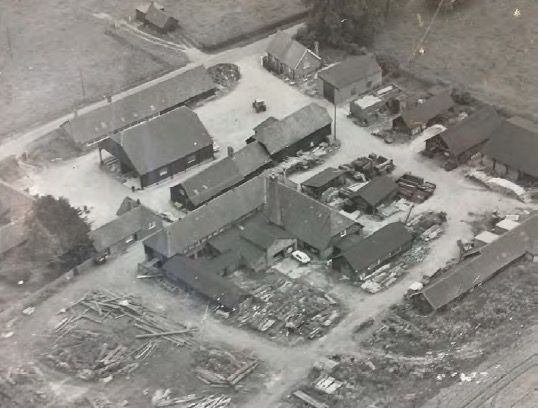

Richard Benyon inherited the estate in 1789 and made it his permanent home in 1802. He immediately set about removing the old village and made a start on building a new one as well as re-routing traffic around the outskirts. A sketch plan probably from the first quarter of the 19th century and by Richard Benyon himself, shows a block of three houses where the range of buildings, including the forge, bordering the road now stand with another pair just to the right and opposite Chantry Lane. By 1844 (right) the site (68) had become the timber yard owned by Richard Benyon de Beauvoir. The part at 67 was rented to Charles Mason, a builder, who lived in the old Pound Cottage at 66 on the map. At 106 is the old Chantry Cottage and both this and Pound Cottage were replaced by new buildings later in the century. At 104 is the old number 12 and 13, demolished in about 1892.

By the time he died in 1854 Richard Benyon had more or less completed the road building and built a few new houses. If he did not build many more houses it was probably because he was making the preparations for that by establishing the brick kiln to provide the bricks, and the timber yard for the joinery items that would be required. The beneficiary of these preparations was his successor Richard Fellowes Benyon who over then next 40 years completed the village (as well as other villages in the surrounding area) to the state in which it would remain for nearly 100 years, and more or less the position it is today.
The steam engines
Just before he died Richard Benyon de Beauvoir installed a single cylinder beam engine by Thomas Piggott to power the sawmill and it was this that did the work of sawing the timber that was needed for Richard Fellowes Benyon’s building programme. This steam engine and boiler were replaced in 1900 by John Wilder of Reading for James Herbert Benyon with another by Ransomes, Sims and Jefferies of Ipswich. A second engine built by Clayton and Shuttleworth dating from 1863 was relocated from one of the farms at the same time to power a saw bench.
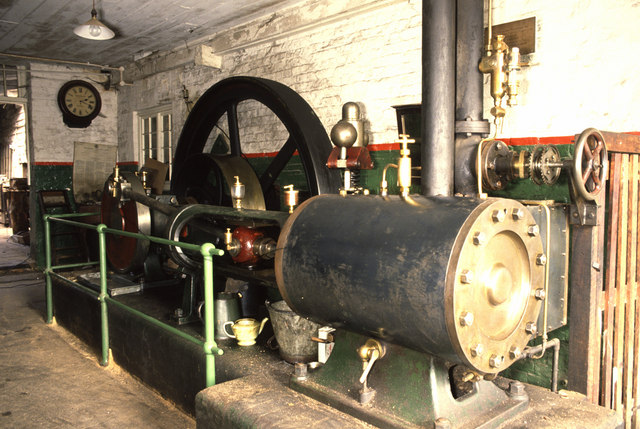
The Ransomes, Sims and Jefferies engine
Chris Allen/Englefield Estate Saw Mill, steam engine/CC BY-SA 2.0
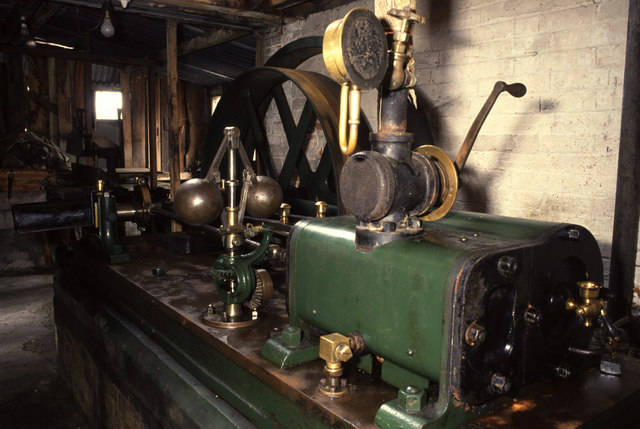
The Clayton and Shuttleworth engine
Chris Allen/Steam engine, Englefield Estate Sawmill/CC BY-SA 2.0
After World War 2 the steam engines fell into disuse with power by then being provided by electricity. Since 1970 both engines have been restored by volunteer steam enthusiasts and both are capable of use on special occasions.
The yard hooter was a constant presence in the village throughout the day and originally this would have been operated by steam from the boiler for the engines. It was obviously converted to electricity when the steam engines ceased to operate after the war for it was still in use in the 1950s. Even into the second half of the 20th century the estate started work early and came home again for breakfast, the farm workers often with a can of fresh warm milk straight from the cow and in winter the men at the Yard with a bag of blocks for the fire. They went back again until dinner time (as it was always called), then back again to work until the hooter signalled the end of the day. This was possible because home was, of course, an estate house situated conveniently close to their work.
In the 1880s the church and Englefield House began to be lit by gas. This gas was acetylene made in a similar device to that installed at the Workmen’s Club in which water was dripped onto a solid block of calcium carbide. The Timber Yard also had such a device in a gas house attached to the sawmill that was still in place until it was demolished during the 2023 works.
Timber
Timber was not only a resource for building on the estate itself but also an important source of income. In March 1847 there were advertised for sale by auction at the Horn Inn, Mortimer 33 oak trees lying at Baughurst, 236 at Pamber, 276 oak and 27 ash trees at Ufton, 95 oak and 10 ash at Mortimer, 51 ash, 7 elm, 9 abele and 5 beech trees at Englefield, all the property of Richard Benyon de Beauvoir. After the Second World War felling was restricted to only what was necessary for use on the estate and for safety and woodland management.
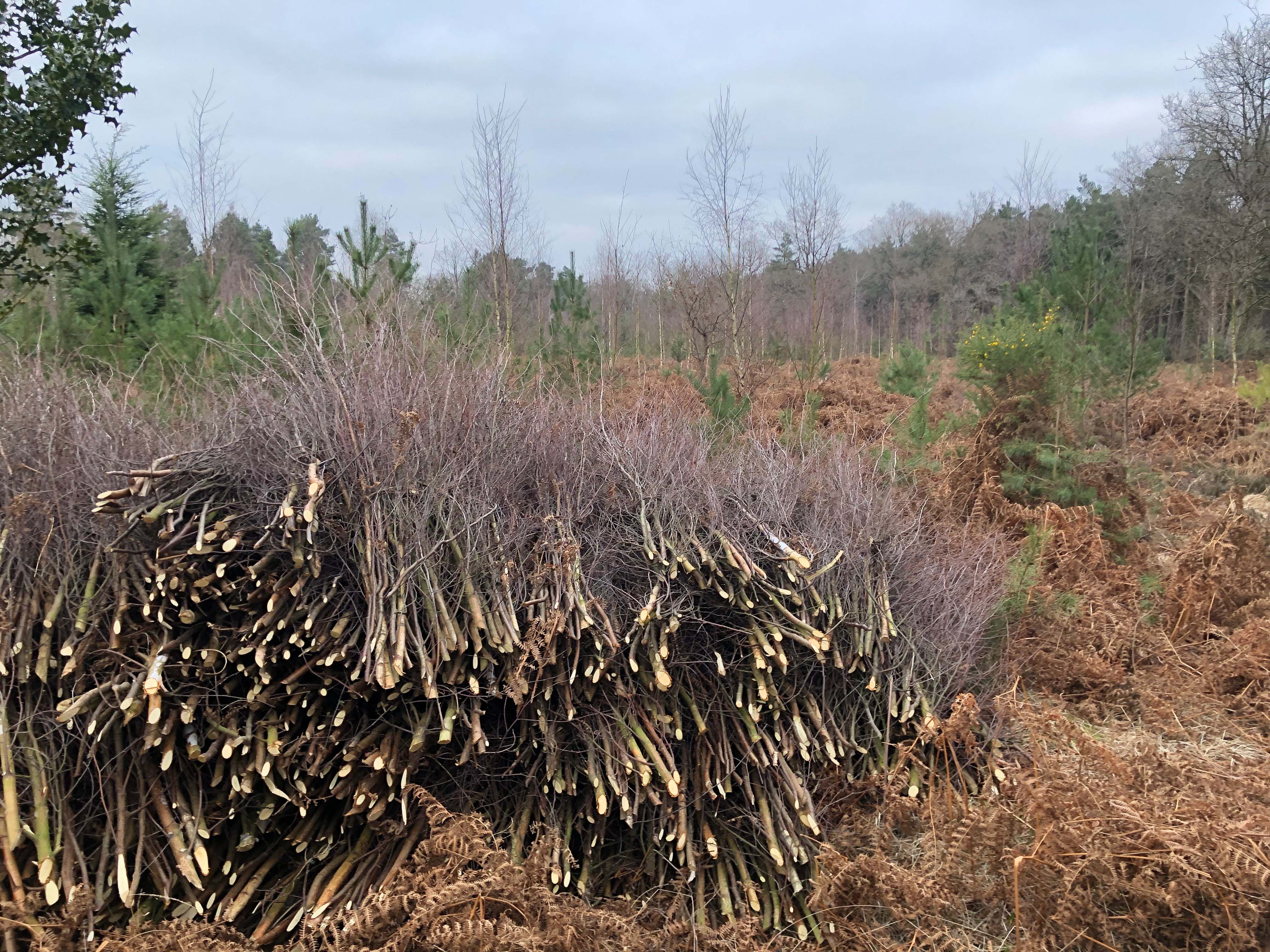
The woodland at Englefield was not commercially managed and is predominantly native hardwoods of all types, although the many elm trees were lost to Dutch Elm Disease, but other parts of the wider estate at Ufton, Mortimer and Pamber Forest are eminently suitable for pine and silver birch which, along with gorse and heather would in fact be the natural flora of this gravel plateau if the land were left to itself. These softwoods are managed as a commercial crop and the birch can be coppiced for a variety of uses; the brushwood shown stacked here is destined for making hurdles on National Hunt racecourses.
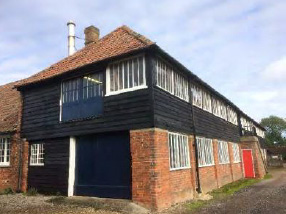
The trees that reached the timber yard were sawn in the sawmill on the lower floor of the sawmill building (left). The upper floor was a carpenters’ and joiners’ workshop.
Some hardwood trees were sawn lengthways into slabs that were then stacked in the shape of the original tree in the open area to the left of the buildings in the photograph at the top of the page, where some remnants can be seen. Spacers between the slabs allowed air circulation while the wood seasoned for several years.

The whole range of constructional and agricultural uses were covered and for constructional use the hardwood at least may have been used green. Some of the softwood for gates, fencing, etc would be impregnated with creosote to protect it from rot and a large pressure tank was used for this purpose.
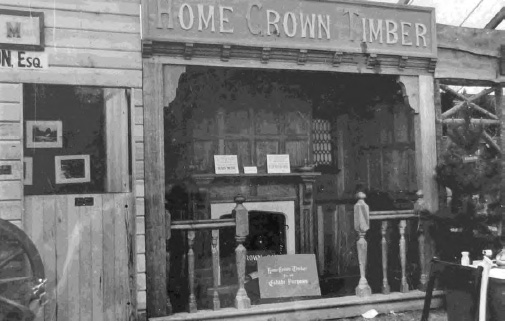
This seasoned timber was then used to make the furniture and other items that were often exhibited at agricultural shows such as the Royal Agricultural Centenary Show in Windsor Great Park in 1939 when the King and Queen congratulated Clerk of Works Frederick Dry on the exhibit which included a panelled fireplace. When the church was rebuilt between 1855 and 1857 all the furnishings were made by the carpenters at the yard and paid for by Mr Benyon.
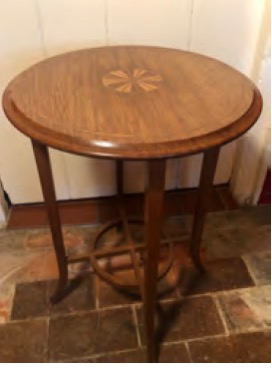
Fuel for the fire was not the only use found for the many offcuts of timber that would otherwise be wasted. Oliver Hopley, a carpenter through the first half of the 20th century, practised his craft even in his leisure hours (when not singing in the choir, playing cricket, out with the fire brigade or at a meeting of the Club committee) and made many small pieces such as the table seen below.