The Numbered Houses
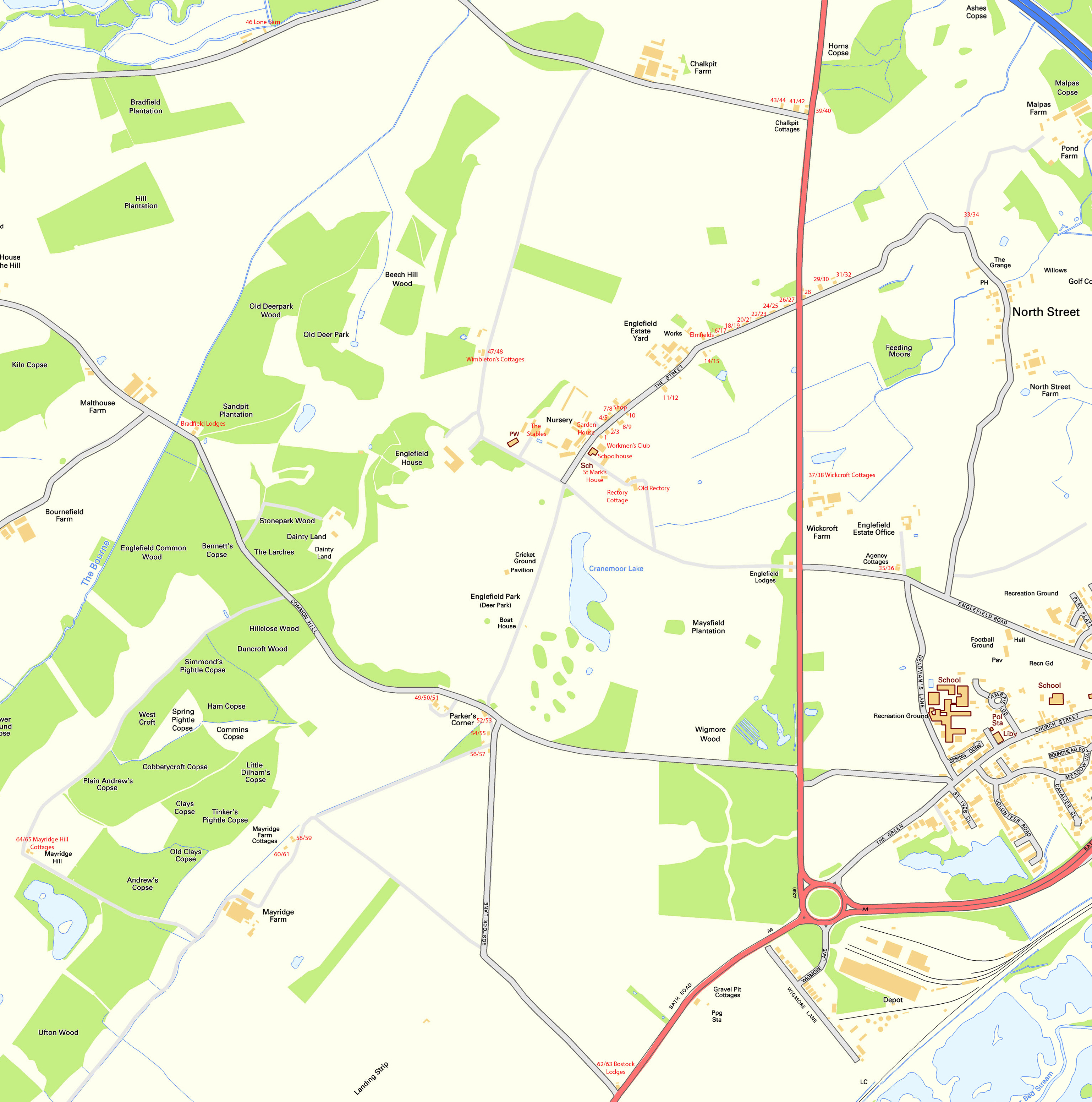
The numbering of the estate houses along the village street is logical enough, except for the missing 13, but when the sequence extends to those houses that are part of the home estate although scattered around the outskirts and in different parishes, then it becomes more difficult. It may be confusing indeed to come across an isolated house numbered 46, apparently at random and with no number 45 or 47 anywhere in the vicinity. Actually in this case there is no number 45 anywhere, though there is a 47 almost a mile away across country but four times that distance on the road.
Rows of houses missing a number 13 is quite a common thing and is usually down to triskaidekaphobia, the morbid fear of the number 13 and its supposed connection with bad luck. That’s not the case with Englefield Street, though, for there was a 13 until it was pulled down in about 1892. Number 13 was one of a pair of cottages (along with the original number 12) that stood opposite the Timber Yard entrance where there is now a shed, and both were certainly there on April 5th 1891, for the census return of that year numbers the houses in Englefield village for the first time and has them both, numbered as such, with the old schoolroom and schoolhouse, by then two separate dwellings, numbered 11 and 11a, just up The Street and numbers 14 and 15 (then a fairly recent replacement for the old Chantry Cottage) further down, immediately before Elmfields home of Clerk of Works William Rhind.
When the houses were first numbered is unclear, but it was certainly before 1881 for the census enumerator for Sulhamstead Bannister in that year has numbered two of the Mayridge Farm cottages as 61 and 62. The other two appear, unnumbered, in the Englefield census so there was clearly some confusion over where the parish boundary ran as all four were actually in Sulhamstead Bannister at that time. Ten years later all four appear correctly under Sulhamstead and are numbered, as today, 59 to 61.
The new school opened in 1863 but in the 1871 census, although no numbers are given, it is clear that the old building was then still a single dwelling occupied by gardener George Swadling, his wife Sarah and their two children, with William Horne (also a gardener) as a lodger. Ten years later in 1881, George and Sarah Swadling were still in part of it (and still with William Horne as a lodger) but the building had been divided and was shown as two properties for the first time, though one of them listed as unoccupied. With number 12 still a little further down The Street at that time the second property would have had to be numbered 11a.
The Ordnance Survey six inch to the mile map surveyed in 1877/78 shows the garden at 11/11a to be divided into two as it is now so it would appear that the numbering of the houses must have been carried out before then but probably only very shortly before because number 8/9 appears to have been built after the 1871 census but before the map was surveyed in 1877. In 1891 “The Parsonage” (unoccupied) appears between numbers 7 and 10 listed as a single dwelling although in 1881 it was listed as two, as it must be to make the numbering work. The original numbering, therefore, looks to have been carried out between the census of 1871 and 1877 survey.
In the 1891 census numbers are used for the first time in Englefield and David Horne and family are in number 11 while 11a is still unoccupied. Less than a month after the 1891 census date, the Rector noted in the parish magazine that “David Horne has removed [from Theale] to No 11a and George Fisher will shortly be in the old ‘Mission Cottage’ which really is No 11”. The Mission Cottage is thought to have been the old single-storey schoolroom that had an upper floor added and it is probable that the census enumerator thought that as the new house this would be 11a and the original house would retain number 11 so this suggests that the two numbers were here being swapped around to be as they are today. In the 1901 census there is a note that there is now no number 13, it having by then been demolished along with the original number 12, and David and Mary Horne (now with six children) are listed in number 12 with Parish Nurse Jane Fair in 11 with her daughter and niece.
The missing number 45 may be accounted for in a similar way. Number 44 is the last one of the Chalkpit Farm cottages going in the direction of Bradfield and the next house along the road is 46, a single dwelling at Lone Barn. However a look at the front of the house shows that two doorways, one at each end, have been bricked-up and replaced with the present single doorway in the centre. It looks, therefore, as if the two dwellings that were listed there in 1939 were later made into one and it was the number 45 that was discarded. The same treatment has been given to numbers 31 and 32 North Street with the loss of 32.
The majority of the changes between 1891 and 1901 were in the higher-numbered outlying houses, and these were certainly renumbered as a consequence of the demolition of Blyth’s Cottages and Goff’s Farm Cottages which were numbered 46 to 51. The three houses at Wimbleton’s were also replaced by two new ones in 1892 and another pair of cottages was built at Parker’s Corner, too. The old houses along Bostock Lane (Miss Winchcomb’s “Bostock Castle”), also demolished at this time, were never part of the original numbering system having previously been numbered 1, 2 and 3 Bostock Lane.
The modern numbering
The numbering as it is today is shown below.