The Village School
Schooldays
Victorian schools were usually structured into two classes: infants from the age of 3 up to the age of 6 and seniors from 6 to 12. At the age of 13 children could start work, though they could work half time from age 9. In 1874 these ages were raised to 10 and 14 respectively. From 1880, attendance at school became compulsory and in order to be able to start work at 10 children had to have achieved at least standard five. At the same time the so-called “dunce’s certificate”, which allowed less able children to leave school at 10 if they had completed 250 attendances, only became available at 13, and then only if they attended half time for further year. These measures increased the school population considerably especially in Englefield, which was noted for large families. After the Second World War the leaving age was raised to 15.
School fees
Until 1891 parents had to pay to send their children to the school despite the fact that education was compulsory and they were taken to court if their children did not attend regularly. In 1882 James Ballard was summonsed to the Reading Magistrates’ Court for not sending his child regularly to school and Mrs Ballard, who attended court in his place, told the Magistrates that she sent the regular fee but the Head Master, Mr Eastman, would not accept it. Fees were limited by law to a maximum of 9d per week and in Englefield were 6d a week, reduced to 2d a week for the first child and 1d for each further one if the parents were labourers but by authority of the school managers, who had consulted the Education Department, children were fined for irregular attendance and Mr Eastman had raised the fees for Ada Ballard by 1d for that reason.
In May the following year George Hedges was sent home to get money for school fees for himself and his sister, which were in arrears to the tune of two shillings. In January 1876 the Wiggins children had also been sent home for the same reason. The Free Education Act of 1891 provided government grants of up to ten shillings a week and the children at Englefield had free schooling from the start of the new term on 11th September that year.
Secondary education
Few village children continued in education beyond the earliest possible leaving age, particularly in places like Englefield where there was a ready supply of jobs in the estate yard, in the gardens and on the farms. However, many of those who left at 13 were apprenticed in various trades and therefore became skilled craftsmen filling vital roles as bricklayers, carpenters, plumbers, etc. In any case, until the Education Act of 1902 empowered the new Local Education Authorities to set up secondary schools, secondary education was only open to those whose families could afford to send their children to fee-paying schools.
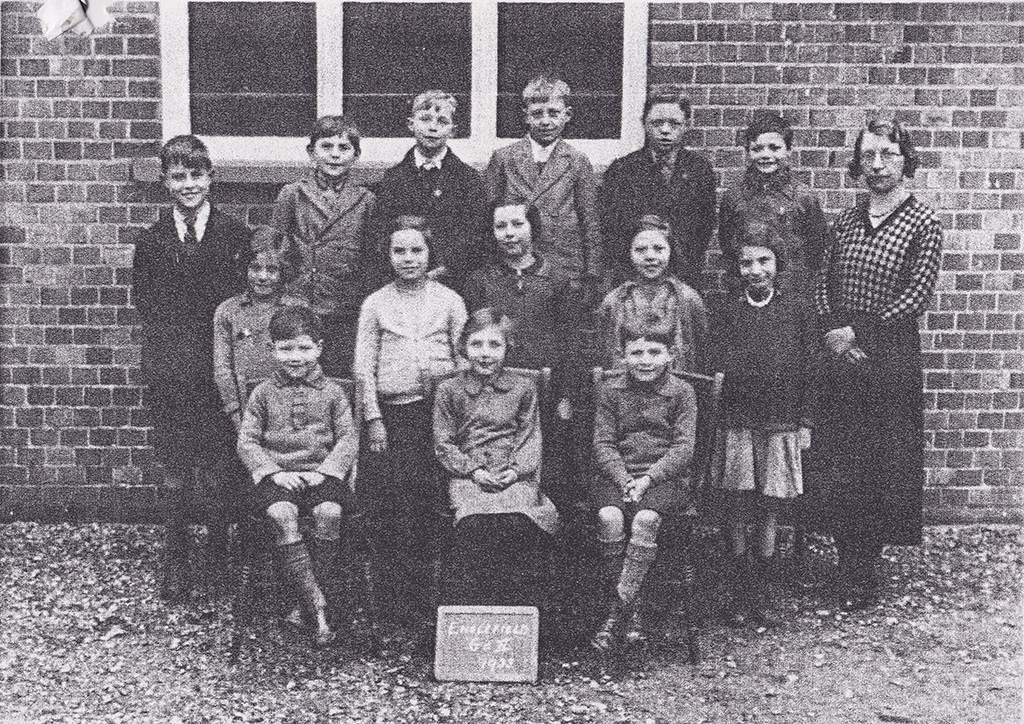
Nevertheless, some scholarships were available from a number of sources, including the new County Councils created in 1889, to those who passed an examination. In that year Stephen Claydon was awarded a Boarding Scholarship of £30 at Newbury Grammar School and Arthur Horne a day scholarship of £10 at Kendrick School in Reading. Emily Horne passed the examination but did not gain a scholarship. From 1907 the new grant-aided secondary schools had to provide free places for those who had spent at least two years at a public elementary school and passed an entrance test. In 1925 Peggy Cottrell attended Newbury Girls’ School for such a test (result unknown) and in 1935 Graham Fisher (centre of the back row in the picture left) was granted a special free place at Newbury Grammar School. His grammar school education enabled him to become the bomb-aimer in a Lancaster aircraft in 1944 when after two years in training he was killed with all his crew mates on only their second mission.
The 1944 Education Act that raised the leaving age to 15 also introduced the “Tripartite System” of secondary education consisting of grammar schools, secondary technical schools and secondary modern schools, though not all authorities provided technical schools. The allocation of pupils to the various types of secondary school was determined by the 11-plus examination but the difficulty in building enough secondary modern schools meant that the new system did not take effect until 1951, although at Englefield in 1949, ten children took the intelligence test and two took the full range of examinations. In 1952, five children aged nine took the intelligence test.
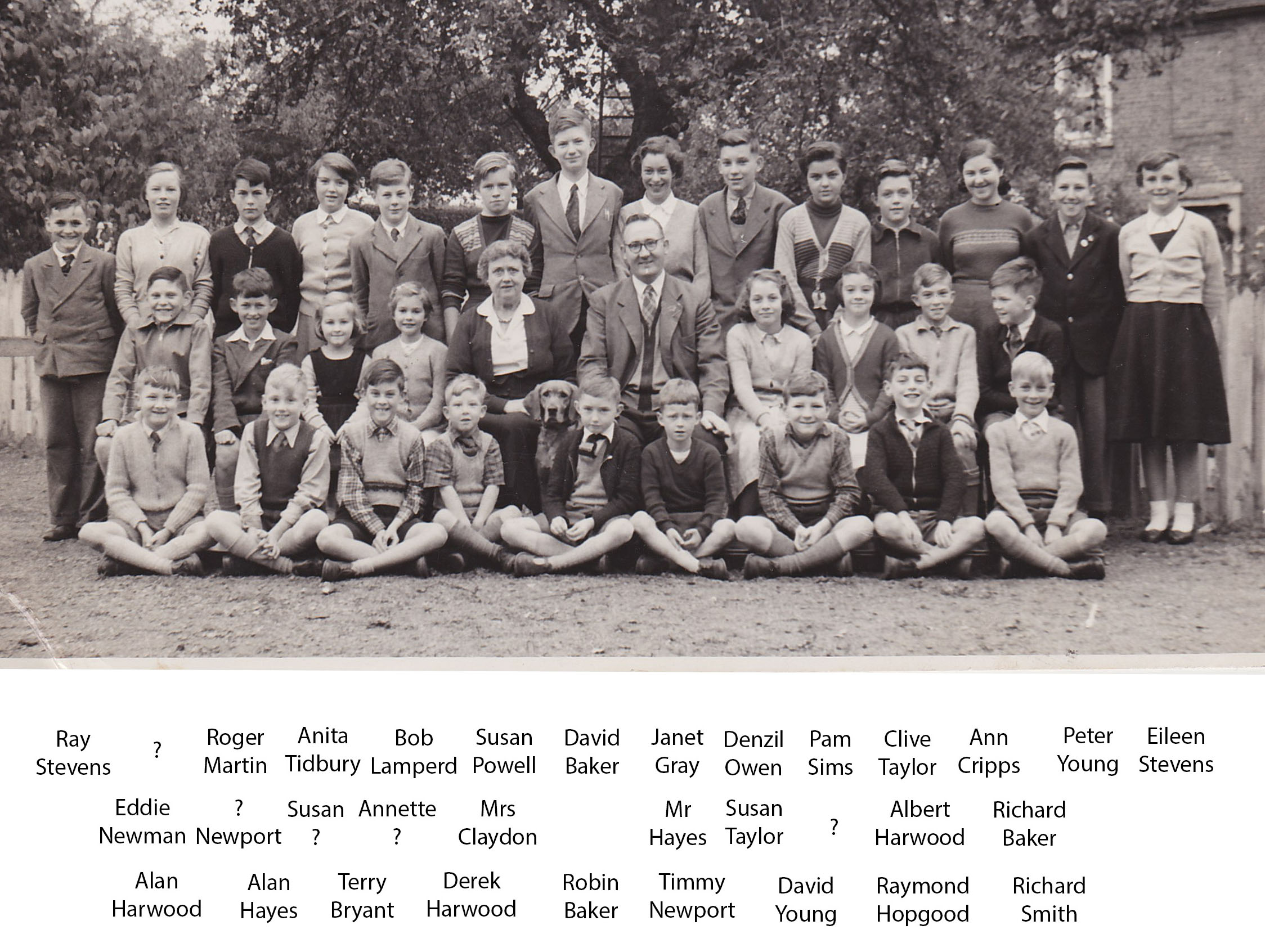
In September 1956 the new Willink secondary modern school opened in Burghfield Common and the twelve senior children at Englefield were transferred there. From then on Englefield became officially a one-teacher school for children 5 to 11 only, although it actually continued with two teachers until the retirement of Mrs Claydon in 1958. The grammar school normally allocated to Englefield pupils who passed the 11-plus was at Newbury a 14-mile bus ride away, with classes also on a Saturday morning. A few children managed to get into Stoneham (boys) and Westwood (girls) grammar schools at Southcote in the Reading Education Authority area, a much shorter journey and with no Saturday attendance.