
The Village School
School life
At the 1891 census the total population of the parish was 320, down from 389 in 1881. Despite this there were 114 children at the school, 25 of whom lived outside the parish boundary (remembering that at this time North Street and Mayridge were outside the boundary, as they still are for ecclesiastical matters), leaving 89 children from the parish, considerably more than the one fifth of the population that the government expected the school to provide for. These numbers certainly explain the fact that as well as the headteacher the school always had at least two assistant teachers in addition to the monitors.
n 1891 when there were 114 children at the school the capacity was 120. The attendance registers for the years up to 1901 were all lost when the Soup Kitchen burnt down in that year but in 1908 the capacity was 120 in the mixed class plus another 37 infants - which would have been something of a squeeze and certainly not enough room for modern teaching methods. While the actual numbers in the mixed class remained fairly constant at around 55 through the decade, the number of infants suffered a decline from 30 in 1904 to only 18 in 1907. This pattern was repeated between 1924 and 1934 with a fairly steady average of 40 in the mixed class but declining numbers in the infants, from 12 in 1924 down to only nine in 1934 despite a sudden peak of 23 in 1927. Through the second half of the 1930s the numbers in both groups declined, down to 28 mixed and only 6 infants by the start of the Second World War. At the end of the War the senior numbers had declined further to 19 but the infants numbers had risen to the same figure. The 1950s saw a rather more serious decline in numbers from 37 in the year Queen Elizabeth II came to the throne down to just 12 by the end of the decade. The main cause of this sudden fall was the opening of the new Willink Secondary Modern school in 1956.
The small number of children remaining at the school was almost responsible for its closure but instead nearby schools at Sulham and Tidmarsh with similarly small numbers were closed and their pupils sent to Englefield. This bolstered the numbers sufficiently to ensure viability.
Absences
In rural areas children could be excused from school for up to six weeks to help with agricultural work and this often happened at Englefield. The long summer holiday was even called the “Harvest Holiday”. In May 1865 it was noted that several lads were away haymaking and on 2nd July that year a very poor attendance was recorded on account of a number of boys out at work. In June four years later the attendance was small on account of “haymaking and bee-minding”. In October 1870 it was noted that 73 children were away on the morning and 76 in the afternoon, probably because the high wind during the night had blown down a great number of acorns. The acorns could be sold to Mr Benyon’s gamekeepers and in 1894 the Rector reminds us that “it is not lawful but downright robbery to sell them to any other person”. The acorns were stored in the barn at Wimbleton’s and used to feed the deer through the winter.
Illness was one cause of absence and in the later years of the 19th century Englefield suffered a number of epidemics including measles in 1881, 1884 and again in 1893. In 1881 the school was closed from 14th January to 19th February. In 1893 a measles epidemic, which resulted in scarlet fever, caused the school to be closed on 12th October when 36 children were absent. When school resumed on October 23rd it was found that a further seven fresh cases had occurred in the previous two days so the school was closed by the managers for a further three days and this closure was then extended by the sanitary authority until 3rd January 1894. Four children from two families died in this epidemic: Margaret and William Eyles from number 3 in The Street and Jesse and Cecil Povey from Malthouse Farm. An epidemic of mumps occurred in 1897 when it was noted on 5th February that “The attendance today is the worst the school has ever experienced, there being only seven children present in the infants and 39 in the Mixed School; 57% of the whole. Mumps and very wet weather are the two causes”. There was also smallpox in 1871 but individual medical reasons also accounted for many absences. Ringworm was quite common and in 1883 Mrs Wise was asked to keep Louisa at home until a ringworm on her neck had disappeared. A year later Fred and Elizabeth Cooper were sent home with ringworms and in 1889 Mary and Martha Harris were sent home with instruction not to return “unless their swarming heads are thoroughly cleansed of vermin”. Also in 1883 Mrs Fisher was asked to keep Nellie at home until the pimples on her hands had disappeared.
The weather, as noted in 1897, was a common cause of absence with snow and heavy rain making it difficult for children to get (on foot, of course) from the outlying houses. In January 1940 much snow and frost was the reason for a poor attendance with only 24 out of 57 pupils present. In this the evacuated London children did rather better than the locals with 10 present out of 17 whereas the local children could only muster 14 out of 40. It may be that the London children were accommodated nearby while many of the local children came from more outlying houses. A little later, in the 1950s, for example, Ann Cripps lived at Lambden’s Farm Cottages and used to walk to school (a distance of two miles) with her mother and sister across the Park, where they were sometimes chased by cows.
At the other extreme, in June 1869 it was reported in the local paper that “On Monday morning, about a quarter past 11, during the fiercely hot sunshine which then prevailed, a boy, attending the National School at Englefield, named James Ballard, was struck down by a sunstroke. He fell like one dead, and remained in a state of insensibility for two hours. He was most assiduously cared for, and all the usual remedies administered, pending the arrival of a medical gentleman, for which a man on horseback was despatched. The boy fell in one of the rooms at the School at the very moment he had returned from a few minutes’ recreation during forenoon school. Under the care of Mr. Cox, the boy (who is about 12 years old) is slowly progressing, and it is to be hoped no permanent injury will follow”.
Less legitimate excuses for absence included the Cavalry exercising at Theale in 1865, the General Election in 1868 and the hounds meeting in the village. In February 1893 the Master of Foxhounds, Mr Bligh, asked that children be let out of school at eleven to see them, but as no holiday had been given the previous year the managers declined. In February the following year when hounds met John Bond and William Fowler took matters into their own hands and “played away” all one afternoon.
Despite all this, in 1904 the attendance for the three months to May was the highest percentage in the Bradfield District and in 1910 George Claydon received from the Education Committee a silver medal for seven years’ perfect attendance.
Punishment
Corporal punishment was, of course, common for both boys and girls, although there seems to have been little of it recorded until Henry Best, a notorious user of the cane, came to the school in 1883. In a single month that year Albin Jupp, after being cautioned for his “daring ways” received two stripes of the cane for throwing some kind of hard substance around the room, E Allen, J Allen and W Elliot were all given four stripes on the hands for failing to do homework even though given extra time in class the next day, and for talking whilst changing lessons Kate Davis was given two stripes, Sarah Bradley three, Fred Coombes four and Solomon Allen and Walter Abery five each. In June 1883 Chas Phillips was given two stripes for putting his toe on the seat of Walter Abery as he sat down “thereby placing him in danger”. A month later Walter Hall received six stripes for calling William May “a devil” and in October A Adlum was punished with two stripes after the Monitor heard her use the words “you’re a silly brute”. After Ernest Allen’s mother complained, Best stated his policy as “with regard to lesson work, never to use the cane unless nothing at all in the way of honest work is done; also with regard to talking, never to use the cane for less than six times talking”.
The school log book for 1886 records that “Agnes Harris, an infant, being very sulky and refusing to obey her teacher force was used and she was compelled by the cane to do that required of her”. Agnes’s father took her to Dr Cox and told Best that in consequence of two marks on her arm he must take the child from the school and expose him unless he paid the doctor’s bill. This was reported to the school managers and although the outcome is not reported, Best was replaced by Henry Sait the following year.
Having “played away” in 1893 to see the hounds, John Bond was “duly whipped” but William Fowler who got very wet and caught influenza was considered to have suffered enough. John Bond left the school at 14 and became an apprentice wheelwright on the Estate but later left to become a carpenter with the local firm of E C R Wigmore at Theale where he remained for 50 years. In 1969, then living at Beenham, he celebrated his 90th birthday with a party at Beenham Village Hall.
Other punishments were also used: Miss Winchcomb recalled being punished in about 1900 for talking in class by being made to stand on one of the wooden forms with a duster tied over her eyes. “Not a pleasant experience for a small child”, she remembered. Ernest Allen was another who suffered the same punishment.
Royalty
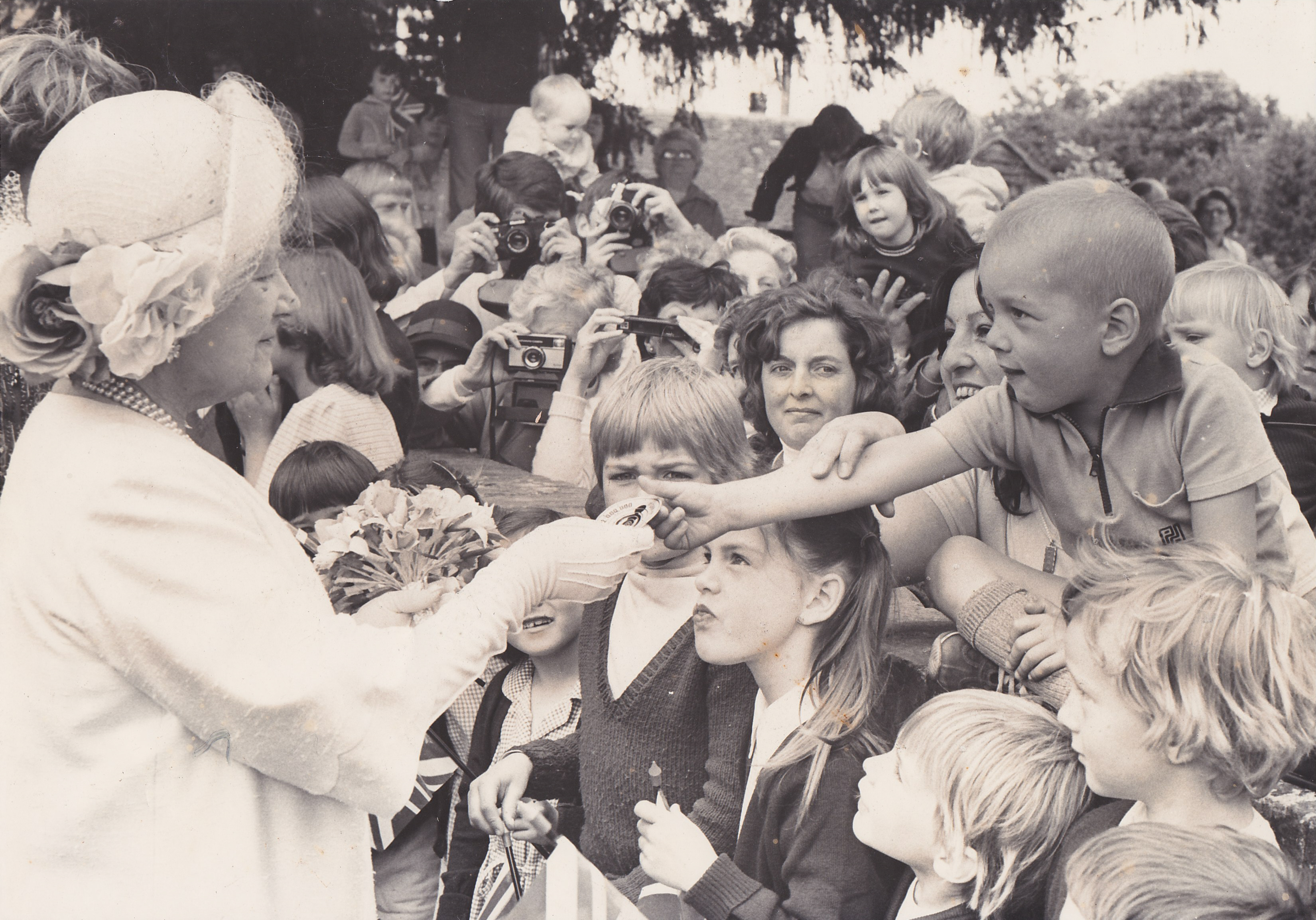
The school was closed for a week’s holiday on 29th May 1953 in celebration of the coronation of Queen Elizabeth II. The Queen visited Englefield House in November 1956. Coloured lights, flags and other decorations lined the road by the school. Villagers and their friends filled the school playground and the schoolchildren lined the road. To a great cheer the car came to a halt outside the school, the Rector made a speech of welcome and Lorna Young presented Her Majesty with a bouquet of lily-of-the-valley and pink rosebuds.
Princess Margaret visited Englefield House on 19th July 1950 and Mrs Benyon asked the schoolchildren to see her at Appleton’s Corner when Janet Soper presented her with a bouquet of carnations.
On 20th January 1955 the Duke of Edinburgh landed by helicopter in the park to watch a display of farming procedures and the schoolchildren were allowed to watch his arrival.
In July 1980 the Queen Mother paid a second visit to Englefield, her first having been, when Queen, to the hospital at Englefield House during World War 2.