
The Workmen's Club

The building of the club began in 1884 and it was opened with great ceremony by Mr Benyon on 1st January 1885 as a Workmen’s Club and Reading Room. Mr Benyon had paid for the building for which a nominal rent of five shillings was to be paid, if demanded.
A committee of management was appointed to remain in office until Lady Day next, when a general meeting of members would be held and a new committee would be elected by ballot. The Club President was, of course, Mr Benyon with the Rector and the Club Steward as other ex officio committee members. The remaining members of the committee were to be elected annually.
Members had to be aged at least 17 and either be parishioners of Englefield, live in one of Mr Benyon’s houses or work on the estate. The subscription was one penny a week, payable quarterly in advance. Hours of opening were between six and ten in the evening from Michaelmas to Lady Day and from seven to ten from Lady Day to Michaelmas.
Smoking was permitted but refreshments were not considered desirable as most of the members would live close at hand. Books were available for use in the room only and daily, weekly and illustrated papers were also available at the expense of Mr Benyon for the first six months. Draughts, chess, dominoes and other games were provided but cards and gambling were not permitted. Political or religious discussions were strictly prohibited.
In its alcohol-free guise the club did not prosper and on 16th June 1886 it was re-opened with ginger beer, made by Mr Claydon, squash, whisky, gin, rum, brandy and beer for sale as well as cigars and tobacco.
Next door to where the Workmen’s Club was built had been the Crown Inn, later Crown Cottage, and there was also at that time another inn, called the Three Daggers, in the village. Well before the 1880s, though, both of these had gone, although there was the New Inn and the Thatcher’s Arms at North Street as well as many public houses in Theale. The Club was intended as a place for the men to go in the evenings to keep them away from these places: “In the public house there a risk of noise, bad company and excess of drink, dangers which the Committee hope to avoid in the social gatherings in the Club” as the Rector put it.
The Club originally consisted of a single large room (in the centre of the picture above with the gable end facing) with living accommodation for the Steward attached (left of the gable end). In 1892 the porch was added and in 1894 the Billiard Room was built at right angles to the main clubroom, across the school playground (right hand side). The billiard table was installed in early 1895 and first game (of “50-up”) was played between the Secretary (A E Robinson, the Schoolmaster) and the Steward on 5th March that year. A raised dais ran along the west wall of the billiard room with a long settle for spectators and those awaiting their turn to play. Players were allocated half an hour for a charge of twopence. The bar cellar was the small flat-roofed, single-storey addition built into the angle between the main Club room and the Steward’s house (with blue door facing) and service was through a hatch in the wall between it and the clubroom. This may not have been added until 1895 when it is known that the matching extension to house the Post Office was built (left, behind the wooden fence). In the 1930s an extension was added on the south side of the Billiard Room to house a ladies’ cloakroom with WC and a wash basin with a cold tap. Toilet facilities were also provided for the men in the space between the boiler room at the back of the main clubroom and the coke store.
The Steward’s accommodation initially comprised a living room and kitchen on the ground floor and three bedrooms upstairs. The living room was known as the “Committee Room” and initially used for meetings of the Committee. An extension to the Steward’s accommodation was added in 1909 and comprised another downstairs sitting room and a large larder, with a bedroom above. Until the ladies’ cloakroom was built the women who attended the dances used the bedrooms of the Steward’s family as cloakrooms. The standard of accommodation was probably normal for the 1880s when it was built but remained little improved for the next 80 years.
The Stewards
In the first 75 years of the Club’s existence there were two Stewards. The first was Mr James Claydon who also worked as a gardener and in 1892 the Steward’s remuneration was £4 a year, with a gratuity of £1 for Mrs Claydon. From 1st January 1893 the salary was raised to £6.
In addition to catering for functions at the Club, the caretaker was also responsible for erecting the Members’ Tent at cricket matches (for which 2/6 was paid in 1892) and for providing the teas.
In 1930 Mr and Mrs Claydon retired and Mr Cook took over having just left the Army after 26 years’ service with the Royal Berkshire Regiment, including seven years in India and the First World War in France. He was recommended for the job by Captain (later General) Miles Dempsey (the alternative was as Gate Keeper at Blenheim Palace) and he was engaged to take up his duties on 1 November 1930. The remuneration as Steward of the Club then was then £1 per week, with additional payments as determined by the committee for catering for the various functions. By 1949 the salary had doubled to £104 a year, although no mention was then made of any extra payment for functions. The following year the flat annual rate was replaced by an hourly rate of two shillings and threepence. Coal and light were provided and the house was free of rent and rates.
In addition to the jobs of Club Steward and Sub-postmaster he also took over from James Claydon the responsibilities of groundsman of the cricket field (which hosted lacrosse matches for the Berkshire Ladies team in the winter) and provider of teas at matches. Another role was as treasurer of the football club. At the outbreak of the War in 1939 all these extra duties ceased (although he then became the Chief Air Raid Warden) and were not taken on again afterwards.
When Mr Cook retired in 1963 he was briefly succeeded by Mr Ron Lee and then he by Mr and Mrs Sergeant, by which time the Workmen’s Club had become a general members’ social club open to all rather than just the preserve of the estate workmen. At the end of 2018 it succumbed to the pressures afflicting so many rural licensed establishments and closed its doors. After extensive refurbishment, including the removal of an accretion of modern extensions and a return to the original design, the Club has reopened as a Village Hall run by a charity.
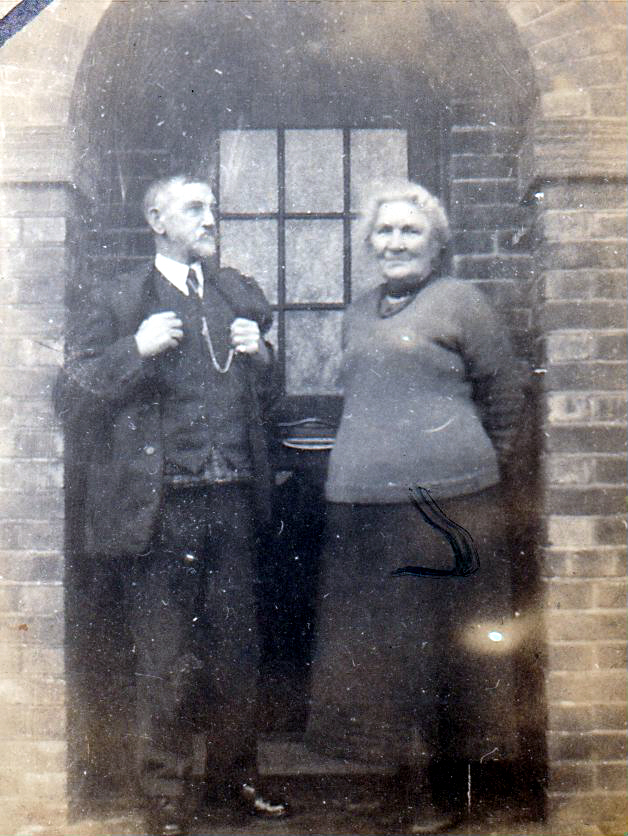
Mr and Mrs Claydon at their home Anningsley in Burghfield Common
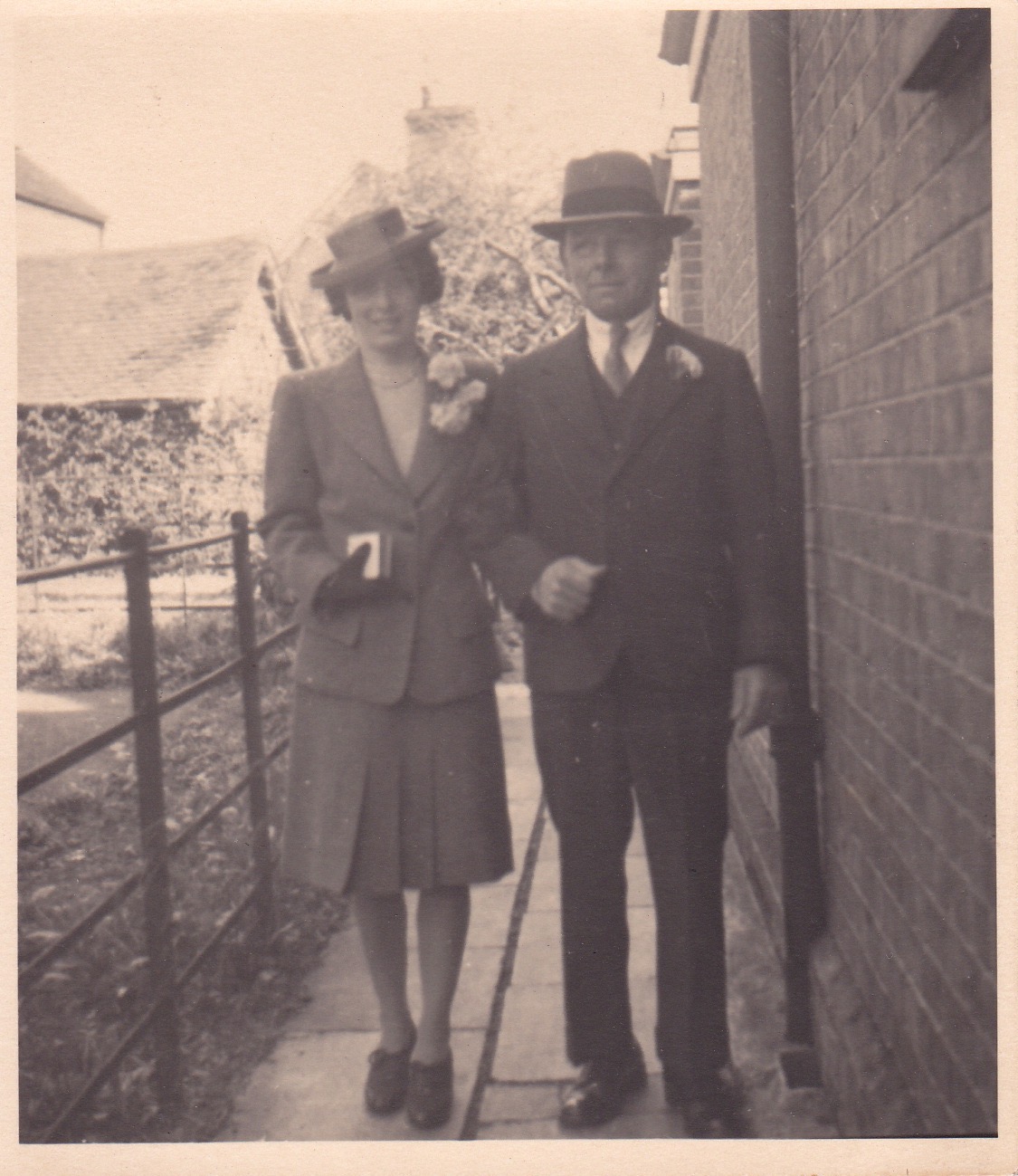
W G Cook with his daughter Emily on her wedding day