
The Post Office
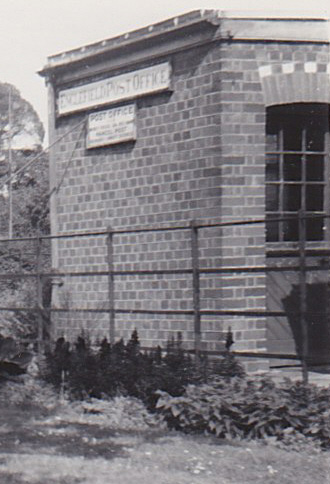
A sub-post office was opened in Englefield in 1895. It was the decision of the Post Office authorities that the post office should be at the Club, in a small building constructed for the purpose rather than at the shop. This is the left-hand square single-storey extension on the front of Club Cottage (below). This was very small and inside was divided across the middle by a broad counter so there was only room for about two customers at a time.
Postal services came to Englefield in June 1838, the month of Queen Victoria’s coronation, and before the post office was opened there was a post box in the high wall surrounding the Gardens. This was emptied at seven o’clock each evening and the children were sent to wait for the postman who sold them stamps. The postman had a pony pulling a red cart and came through the park from Bradfield by way of the Bradfield Lodge gates. A new post box was incorporated into the side wall of the post office to the right of the door.
Local mail deliveries were made from the Englefield Post Office until the Second World War so in those days post office duties began at 6am with the arrival of the mail from Reading. This had to be sorted into the rounds ready for the postman, if there was one. If not, the family had to make the deliveries and Mr Cook would go one way and his son James the other. The rounds extended to Parker’s Corner, Bostock Lodges, Daintylands, Beenham Lane, Englefield House and Wimbleton’s one way and The Street, Chalkpit Farm and Tidmarsh Moors the other. The second delivery would arrive at 1130 and this would be delivered by Mr Cook’s elder daughter Renee. This was a shorter round comprising only the Street, North Street, Blossom Lane and Blossom End. This was later taken on by the younger daughter Emily after Renee started work as a children’s nurse.
Mr Cook took over the role of Sub-postmaster when he became the Club Steward in 1930, although the most of the work was done by his wife, later assisted by their younger daughter, Emily. For a long time the post office had one of only four telephones in the village (the others were Englefield House, the Rectory and the Clerk of the Works) so it was not unusual for the family to be knocked-up in the middle of night to phone for the doctor. The telephone number was initially Theale 66, changed to 366 in the 1960s. A public telephone box was later installed outside the Club entrance.
The post office opened for business at 8am and for many years stayed open until 7 at night. After closing, all the letters had to be stamped and put, in neatly-tied bundles, into the mail bag. The bag was then tied with string and the knot sealed with sealing-wax and stamped with a special seal. The mail van from Reading came at 7.30 and after cashing-up the day was over - provided there was no function at the Club to cater for.
In 1930 when Mr Cook took over from Mr Claydon at both the Workmen’s Club and post office the salary for the Sub-postmaster was about £40-£45 per year and in 1961 had risen to £231 5s. This was based on a formula calculated from a triennial return of business conducted and that for 1960 shows that then pension payments formed a large part of the business but much larger still were the sales of Postal Orders and National Insurance Stamps - all declining or completely lost business these days.
By 1968 post office services were moved to the village shop but were withdrawn altogether in 2008.
When the post office was first opened, the Club Committee decided to sell a few articles of common everyday use from the Post Office, forming an association to carry on the business. It was convenient that the Club Steward was also the Postmaster. It was not intended to interfere with local trade (so they presumably only sold things that the shop didn’t) but to retain any profit that might be made in the village, rather than losing it to the traders who constantly came through the village with their carts. The kind of things that were sold are shown on this trade card produced at the time. This initiative certainly ceased before 1930.
