
St Mark's Church
Bells & Music
Music was not a feature of the ordinary parish church after the Reformation and singing was confined to chanting the Psalms but by 1800 hymns had made their appearance and in the next century, particularly under the influence of the Oxford Movement, the fully-robed choir seated in stalls in the chancel appeared in parish churches.

Certainly from the time of the rebuilding in 1855 the choir was a prominent feature in St Mark’s and at this time appears to have contained girls as well as men and boys, for Miss Winchcomb said her mother, born 1856, was a member and sang with the choir at the annual choir festival in St Mary’s Reading, first held in 1862. The girls wore red cloaks and straw hats presented by Miss Frances Benyon. A photograph of the choir was taken in 1901 at the west end of the church but the one above must be later, probably about 1910, and is obviously taken at the back of the Englefield Chapel.In 1889 Mr Benyon gave cash prizes to the boys who had the best record of attendance at practice and services in the preceding year and at Christmas that year two visitors to Englefield House, Mr and Mrs Whateley, also gave each boy half a crown in recognition of their singing of the carols. In 1893 Miss Benyon gave each boy an “Easter-egg” of 2/6d. In 1889 Mr Davis, the organist from St Giles’ Reading, was engaged to give some extra tuition, apparently with immediate and beneficial effects. This meant an extra practice session each week between January and May in addition to the usual two evenings.
In 1938 it was decided to pay the boys 2/6d per quarter for full attendance and pro-rata for less. The following year the quarterly payment was reduced to two shillings and girls were re-introduced into the choir. Payment was not offered after the War. There was an annual outing for the choir in the summer and Christmas parties provided by the Rector and Mrs Benyon.
Boys left the choir when their voices started to break but many returned once things had settled down. Some boys did not join the choir but did not let this hamper their vocal efforts in church for in June 1905 the Rector pointed out that the object of the choir was to lead the singing, requesting the younger members of the congregation to remember this and appealing to their better feelings to “try and render all music in as reverent a manner as possible”. In 1892 there was apparently a shortage of men and the choir was filled up with boys “without quite sufficient care as to the character of those we have admitted”. Those boys whose “…conduct, and steadiness, and behaviour, and reverence, we are not so well able to trust as we could wish…” were not allowed to go on the annual choir outing.
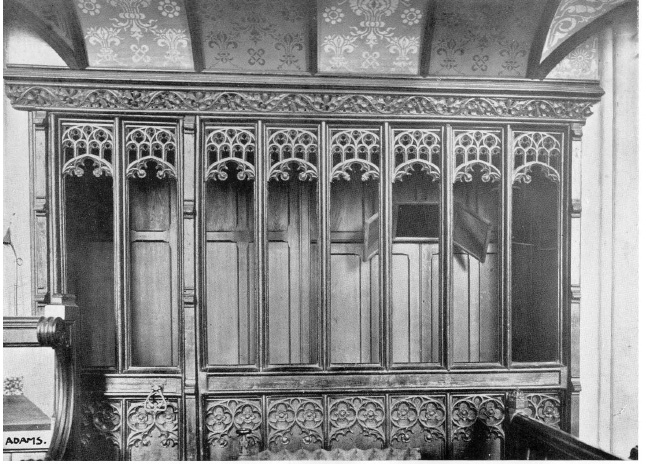
The organ occupying the Englefield Chapel behind the old rood screen
The organ
With choirs also came the organ, usually situated on the north or south side of the chancel. In many churches the space this took up caused great inconvenience but in Englefield the organ was put into the Englefield Chapel behind the portion of the old rood screen with the pipes on the wall above. In January 1895 the Rector refers to “…our ‘Jubilee’ organ…” and the Reading Mercury of 12th November 1887 (the year of Queen Victoria’s golden jubilee) reports the erection of “A very fine-toned organ, the gift of Mr Benyon [which] will be performed on for the first time on Sunday the 20th...”. Miss Winchcomb says that when her mother was in the choir in the 1860s they were accompanied by a harmonium. The organ was subsequently enlarged by Mr T T Ginn from London who regularly came to tune it, and in fact died suddenly one night at the Clubhouse while on such a visit.
The harmonium was used in 1891 while the chancel was screened-off for the alterations and the choir occupied the front row of seats in the nave. By 1907 the organ was in need of repair, twice failing during the course of a Service with all attempts to correct things by the organist and blower being ineffective and the singing necessarily continuing unaccompanied. The organ was repaired in 1910 by Mr Trunks of Clapham at the cost of £55, borne by Mr Benyon. While this was being done the harmonium was again used to accompany the singing.
By the time of the Second World War the organ was again needing repairs and the harmonium was brought back into service instead. After the War the repairs were made and an electric blower was installed, relieving one of the boys of an onerous task, failure in which was all too obvious.
During his tenure as Schoolmaster (1890-1903) Mr A E Robinson was both organist and choirmaster and both these roles were taken on by his successor, Mr Golding. Arthur Claydon, the son of James Claydon the caretaker at the Workmen’s Club and sub-postmaster until 1930, played the organ from 1938 until 1968.
A new organ keyboard was installed at the back of the nave in 1985 with the original mechanism and pipes placed alongside, against the west wall of the aisle.

Arthur Claydon seated at the organ
The bells
Englefield has a set of eight bells, six of which form the original set cast by Thomas Swayn in 1774 and presumably re-hung after the tower and spire were rebuilt in 1868. The two additional bells were added in 2002 at the instigation of Sir William and Lady Benyon. Over the years many men from the village became ringers and the parish magazine notes that on the evening of Wednesday 17th June 1891, William Vince, Thomas Cox, James Abery, Thomas Harris, Edward Horne and John Abery rang for the first time 720 Grandsire Minors, the full number of changes that can be rung on six bells. In June 1897 Ernest Bruce, William Lucas, Charles Giles, Alfred E Reeves, Frederick Richardson and William Horne rang, in 2 hours and 45 minutes, 5040 changes comprising 720 College single and two each of 720 Oxford Bob, Canterbury Pleasure and Plain Bob minor. Later, on 18th September 1898, a peal of minor, 5040 changes was again rung over 2 hours and 40 minutes and is commemorated on a peal board in the tower. The ringers were: William Vince, James Abery, William Horne, Henry Tucker, Alfred E Reeves and Charles Giles who was also the conductor. Oddly this finds no mention in the parish magazine despite the then Rector being a member of the most celebrated change ringing society in the City of London. A similar board alongside commemorates an identical feat exactly 100 years later.
In 1893 some unusual noise was heard in the belfry when the leather that prevents undue noise due to the suspension of the iron clapper from an iron ring wore out and needed to be replaced. In 1910 the bells were silenced for a few weeks due to the unsafe condition of the tenor bell. Mr Webb, of the firm of Webb and Bennett, advised that all the bells should be quarter-turned and new wheels, etc, supplied to them all, a matter of considerable expense. The Squire, however, gave his consent to the work being carried out at his expense. At the Millennium the bells were again turned and re-hung, with a steel framework replacing the original timbers.
The bells were rung regularly for Sunday and other services, as today, with special in memoriam muffled peals being rung at certain funerals such as that of William Horne, himself a bell-ringer. They were also rung on many other special occasions, including Queen Victoria’s 81st birthday and to celebrate the end of the First World War.